July 08, 2008

Michael Gazzaniga Now

I've just seen / heard about a couple of interviews with Michael Gazzaniga, the father of cognitive neuroscience:

He was on the Australian radio show All in the Mind in June, and they introduce him as follows:
One of the big names of the brain is Michael Gazzaniga, whose career was forged in the lab of Nobel laureate Roger Sperry. His striking experiments continue to uncover the differences between your left and right hemispheres. Today he's on the US President's Bioethics Council, heads up a major project on neuroscience and the law, and is a prolific writer of popular neuroscience. He joins Natasha Mitchell to reflect on the brain's left and right, and the mysterious nature of free will.
He was in Australia for the International Human Brain Mapping Conference, and Natasha Mitchell's 30-minute interview covered split brains, the discovery of "blind sight," and free will. You can listen to the podcast or read the transcript; you can also subscribe to All in the Mind via iTunes.

Ross Buck, professor in the University of Connecticut's department of Communication, points me to an upcoming interview in Seed magazine. While the published interview won't appear until the August issue of Seed, you can read the full transcript of the conversation between Tom Wolfe and Michael Gazzaniga. You can also watch a video of the interview at the Seed Salon. About the interview and video, they say:

Tom Wolfe + Michael Gazzaniga

Wolfe, who calls himself “the social secretary of neuroscience,” often turns to current research to inform his stories and cultural commentary. His 1996 essay, “Sorry, But Your Soul Just Died,” raised questions about personal responsibility in the age of genetic predeterminism. Similar concerns led Gazzaniga to found the Law and Neuroscience Project. When Gazzaniga, who just published Human: The Science Behind What Makes Us Unique, was last in New York, Seed incited a discussion: on status, free will, and the human condition.


Note that UConn has several of Gazzaniga's books, and I will shortly order his latest, Human : The Science Behind What Makes Us Unique.

For More Information

June 11, 2008

Giving Good Airport

While on my flight home from NASIG last week, I used my iPod Touch to watch a New Yorker conference session called Deconstructing the Airport. Paco Underhill, founder of market research and consulting company Envirosell, talks about how to remake air travel for the twenty-first century. Underhill has written books on the Science of Shopping and the Call of the Mall (subtitled "the geography of shopping"), and now turns his attention to airports. If I may translate what he does into library / IT language, he talks about usability / user interaction assessments of people as they use airports.

For instance, he says that people's perception of time spent waiting while in a security or check-in line is usually longer than the reality -- up to 50%, in fact! Underhill suggests that the entire airport needs to be completely redone, in part for functionality, and in part to reduce our perception of this long wait time. He gives many examples of functionality, but here are two I liked: the "body bubble" is different in airports than it is in other areas of our lives -- we have only one hand free (if that) and we are pulling / carrying a suitcase, and possibly also a backpack. So our peripersonal space is totally different - but that is not taken into consideration when designing the airport. Another ha! moment: "the filthiest place in the first world is the bathroom in the economy section of an airplane."

As I watched all this, I started thinking that there are a lot of similarities between how Underhill describes the problems with airports and the difficulties some of our patrons face in libraries.

Underhill says: "... we live in a world that is owned by men, designed by men, managed by men, and yet we expect women to participate in it." Amen, brother! (but I digress) Except ... I'm not really digressing. What if we modify that phrase like this:

"... we create a library that is owned by librarians, designed by librarians, managed by librarians, and yet we expect novice library patrons to participate in it." (changed words italicized) It's a slight modification, but all of a sudden some of us might have a better understanding of what the library is like for our patrons. D'oh!

Underhill gives some great ideas on how airports could be "reinvented:"
  • Free WiFi everywhere, among other suggestions to improve incessant travel waiting. again I say, Amen, brother! (and also: thank you! to my local airport, BDL, which does offer free WiFi)
  • Offer different lines at security, for families, registered travelers, etc.
  • Offer healthy food choices! halal, vegetarian ...
  • Shopping (and other services) that reflect a one-handed customer. He suggests offering a wand-style checkout like the Exxon/Mobil Speedpass to reduce physical difficulties paying for items in an airport.
  • Rocking chairs like at the Charlotte airport, and other kinds of movable seating (his demonstration of the rocking movement is charming).
Sounds like it could be called Airport 2.0. Let's hope airports and libraries can both redesign themselves (quickly) to be usable, and functional for real users.

For More Information

June 07, 2008

Presentation on Marketing the Library

I'm just finishing up my attendance at NASIG 2008 (that's the North American Serials Interest Group) on the collaboration between vendors and libraries to market (or promote, if you prefer a softer touch) library databases to patrons.

We broke the session into three groups: Brie Betz, Account Development Manager at Elsevier spoke about the program from the vendor's perspective, and how it's been a great success at the University of Connecticut and other places at increasing usage. I spoke about managing the program from the librarian's perspective and Deb Barberi, one of my GSLIS students and Student Ambassador for the 2007-2008 academic year, talked about teaching the program and working with the UConn graduate students.

The conference folks have created a NetVibes page (Add to Netvibes) for the conference - they're pulling in Flickr photos, blog posts, and other material tagged with nasig2008. Check out all the activity, and see if you can find the photo of me at David Lee King's presentation on Emerging Trends & Web 2.0 on Flickr, or on David's blog.

June 02, 2008

PrimateLit -- free database!

One of my colleagues at the University of Wisconsin has worked on an impressive database called PrimateLit. This database
provides bibliographic access to the scientific literature on nonhuman primates for the research and educational communities. Coverage of the database spans 1940 to present and includes all publication categories (articles, books, abstracts, technical reports, dissertations, book chapters, etc.) and many subject areas (behavior, colony management, ecology, reproduction, field studies, disease models, veterinary science, psychology, physiology, pharmacology, evolution, taxonomy, developmental and molecular biology, genetics and zoogeography).
I did a search for mirror neurons, and found over 200 results -- plus a subject heading for mirror neurons. The metadata is impressive: you can search or browse by taxonomy (macaca), diseases (depression) anatomy (frontal cortex), behavior (theory of mind), disciplines (experimental psychology), and much more!

A cool feature of PrimateLit is that it
... attempts to identify each user's institutional affiliation and automatically provide links to that institution's online journals and other content from within search results. If PrimateLit can't automatically identify the proper institution, the user is prompted to manually set the preference through a simple form.
For librarians, this means that it takes advantage of OpenURL technology, and if you've registered your OpenURL resolver with WorldCat.org, it will automatically display your OpenURL resolver of choice. For researchers, if your library has done this behind-the-scenes magic, it means that if your library has the full-text of an article cited in PrimateLit, you will be able to get to it easily. Click on the "Institutional Affiliation" button on the search page to see if your institution is participating.

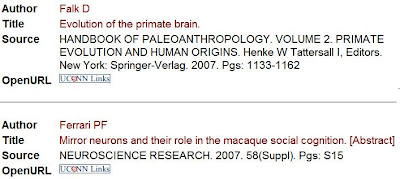
Here's what it looks like at UConn:
Where clicking on "UCONN Links" will ultimately lead you to the full-text of the article, if UConn has it online.

Quite impressive!

May 29, 2008

More About Feline Diabetes & Diet

My first post on Feline Diabetes & Diet is still getting hits in Google searches, so I wanted to update what I've since learned about it ... just to keep the record balanced (or perhaps more muddled).

In that first post, I cited an unpublished study suggesting that carbohydrates weren't less important than weight in treating feline diabetes. Which suggests that carbohydrates aren't bad for cats with diabetes.

BUT!

I’ve since read Your Cat : Simple New Secrets to a Longer, Stronger Life, by veterinarian Elizabeth M. Hodgkins (c2007). She has carefully studied diet and feline diabetes in her practice and she strongly believes that cats shouldn't eat carbohydrates at all. Her own practice suggests that diabetes can be completely controlled by diet, and she cites examples of cats she has known who have switched to all canned food and no kibbles ... and who have no longer needed insulin. But this is only her practice and not a solid clinical trial, so your experience may vary.

Hodgkins pokes holes at some mainstream studies showing that cat food is healthy, and overall makes some very compelling arguments. Primarily, she states that "studies" show that for young cats, a short-term diet including a lot of carbs does no harm; she argues that this does NOT show that long-term, carbs do no harm.

Research is starting to support Hodgkins' arguments. Deborah Greco, DVM, PhD, an endocrinologist at The Animal Medical Center in New York, explained a "Catkin's diet" (Google search results) at the 2004 American College of Veterinary Internal Medicine. Her report was cited in a November 2004 article in DVM Newsmagazine:
Greco notes that in a cat's natural environment, mice would be a main staple, composed of roughly 40 percent to 45 percent protein, 3 percent to 5 percent carbohydrate and 40 percent to 45 percent fat.

"Cats should have a diet that is high protein, high fat and low carbohydrate," Greco says. "High levels of carbohydrates in dry food causes overproduction of insulin, increased hunger and weight gain."

Hodgkins' book strongly encourages cat "owners" to remove all carbohydrates from their cats' diet, and feed their cats nothing but canned food (or even raw food). Note that her recommendation is for ALL cats, not just cats with diabetes.

As a science librarian, I would like to see well-crafted, substantial, long-term, large-cat, published clinical studies of carb or no-carb diet in cats, diabetic or not. But until then, I will be feeding my healthy, non-diabetic cats low-carb, high protein diets in the hope of keeping them healthy and non-diabetic.

For More Information
Disclaimer:This blog is not a tool for self-diagnosis or a substitute for professional care.

May 15, 2008

Updates

In which we revisit some earlier posts and see what's new. This is partly because now that classes are over, I have time to catch up on old issues of the New Yorker and New Scientist, leading to some blog bits.

Crows
Last July, I wrote about the intelligence of crows and scrub-jays. In March, "hacker and writer" Joshua Klein spoke at TedTalks about crows and how he taught them to use a specially-created crow vending machine.


As Klein leads up to the vending machine (truly amazing), he shows some fascinating videos which nicely illustrate how crows learn, specifically a shot of a crow bending a wire to pick up food in a lab, and another shot of a crow using cars to crack her nuts -- then waiting for the light to change so she can collect the nut bits in safety. I won't spoil the vending machine story for you, as it's really fascinating.

Politics, Emotion, and ... Genes?
I've written occasionally about politics and the brain, and I read an article in an early February issue of New Scientist about some studies that suggest "political positions are substantially determined by biology." Jim Giles summarizes recent studies in various journals, and the findings are startling: twin studies suggest that political orientation is genetic (American Political Science Review, 2005); there may be a connection between fear of death, art preference, and one's political leaning (American Psychologist, 2003), and "there is probably a set of genes that influences openness, which in turn may influence political orientation" (Journal of Research in Personality, YEAR). Giles cautions, however, that "there is no shortage of critics who question the whole idea of linking politics with biology." For more, check out the article, or read some of the articles that Giles summarizes.

The Pirahã
I summarized a New Yorker article about the Pirahã about a year ago; in January, New Scientist interviewed the linguist Daniel Everett, who, along with his family, are the only non-Pirahã who speak that language. If you're interested in the story of the language of the Pirahã, and what it says for language acquisition (including a conflict with Noam Chomsky), the interview is a good read.

For More Information
  • Klein, Joshua. The Amazing Intelligence of Crows. TedTalks, March 2008.
  • Giles, Jim. "Born That Way." New Scientist, Feb. 2, 2008. Not available for free online, but full-text may be available @your library, in Academic Search Premier and other databases.
    • Alford, John, Carolyn Funk, and John R. Hibbing. Are Political Orientations Genetically Transmitted? (pdf) American Political Science Review. Vol. 99(2), May 2005, 153-167.
    • Jost, John T. The End of the End of Ideology (abstract). American Psychologist. Vol 61(7), Oct 2006, 651-670. Full-text may be available @ your library in PsycARTICLES.
    • "Heritabilities of Common and Measure-Specific Components of the Big Five Personality Factors" Journal of Research in Personality, vol 32 (4), April 1998, p. 431. Not available for free online, but full-text may be available @your library, in ScienceDirect.
  • Else, Liz and Lucy Middleton. "Interview: Daniel Everett." New Scientist Jan 19, 2008, p42-45. Subtitle: "Out on a limb over language: linguist Daniel Everett went to Brazil as a young Christian missionary to work with the Piraha indigenous people. Instead of converting them, he told Liz Else and Lucy Middleton, he lost his faith and his family, and provoked a major intellectual row." Not available for free online, but full-text may be available @ your library, in Academic OneFile.

May 12, 2008

Pet "How To" Videos from Cornell

I found some wonderful cat videos @ Cornell University College of Veterinary Medicine which provide details on how to care for your ailing cat.


In this case, not even ailing -- but how to brush a cat's teeth. We have a cat struggling with gum health, and we have been brushing her teeth for well over a year. We don't use the implements shown in the video; rather, we use a q-tip and some veterinary oral rinse. And we didn't introduce the new health regime the way the video suggests, tho' if I had to do it over, we would have. (note: early in the video are shots of sedated cats getting their gums cleaned; be prepared to cover your eyes if you don't want to see cats in an operating theater)

They have a long series on Caring for Your Diabetic Cat, which, sadly, I no longer have to do. The video has a great explanation of what diabetes is and how it affects your cat (including some distinctions between feline and human problems related to diabetes), how to give injections, and nutritional therapy. The series on Trimming Your Cat's Claws is very helpful -- and useful if your cats like to scratch things.

If you are caring for a cat, I recommend looking at the list of videos Cornell offers and watching the ones that apply to your cat.

For More Information
  • Videos for Cats, Partners in Animal Health and Cornell University College of Veterinary Medicine. 2008.
  • Videos for Dogs. Partners in Animal Health and Cornell University College of Veterinary Medicine. 2008. Only one there so far; maybe they'll add more soon.

May 07, 2008

Database of Political Ads

There's a cool database of political ads online at http://projects.washingtonpost.com/politicalads/

The Washington Post has collected (links to) over 500 ads in the database, and this is the description of the resources:

The database includes political advertisements funded by campaigns, parties, committees, and independent advocacy groups. Most of the ads are tied to specific U.S. House, U.S. Senate, or gubernatorial races throughout the country. Some of the ads are more general "issue" or advocacy ads not tied to a particular race or candidate. You can search for ads based on the criteria listed below.
They are categorized by campaign, person, content, tone, characters, etc. Some of you may be especially interested in this group of emotional ads.

It's a nice idea in theory, but of the 5 ads I tried to watch, only 2 worked. Still, if you're interested in politics & communication, you might want to check this out.

May 05, 2008

Teaching Citation Searching to Grad Students

One of my student / trainers / colleagues and I co-wrote an article for Computers in Libraries about the UConn peer-to-peer training program. I've written about the Elsevier Student Ambassador Program here before (June 2007), but that post was brief, and the article is more detailed.

Chelsea writes a great deal about how she taught other UConn graduate students the nifty process of looking to see who's cited an article, and by doing find MORE related articles, and finding seminal articles in a particular field. We both like citation searching databases like Scopus and Web of Science because they let you do some very interdisciplinary searching with a few mouse clicks.

The article was great fun to write, and I hope it gives you some ideas about a novel way of searching.

For More Information

May 02, 2008

Friday Fun

Saw this amusing web-based librarian colorforms-like game (anyone remember colorforms from childhood?) where you dress up your librarian any way you like. I pretty much liked the basic buttoned-up librarian, but I did revise mine just a bit to include beads, a splash of color, and un-bunned hair.

take a look at librariandressup.com & see what you think!

(thanks, as always, to Candy)