Showing posts with label brain. Show all posts

September 17, 2012

Concussion Data, Articles, & More


Now that it's football season (Go Giants!), it's also time to rethink concussions in the sport. There have been some good articles lately, such as Melissa Segura's heartbreaking story about three girlfriends/wives of retired NFL players. Also some indications that the NFL and NCAA are taking concussions seriously: Darrelle Revis was held out of yesterday's Jets game due to last week's head injury, and Arkansas' quarterback Tyler Wilson was held out of yesterday's game against Alabama.

Additionally, some of my students are working on sports infographics, including one dealing with concussions. I collected links to data & graphics for that class here as well.


Data on Concussions

Recent articles about NFL concussions & related issues
Bibliographies & Resources

November 09, 2009

Cycling and the Brain

More broadly: exercise in the brain, with an emphasis on cycling. There's a neat article in the Nov. 2009 issue of Bicycling about the effects of cycling on ADHD. The focus is on a first-year college student named Adam Leibovitz, in the lead article Riding is My Ritalin, in which Leibovitz is able to control his attention difficulties with long bicycle rides.

There are a few interesting sidebars in the article.
  • Christine Mattheis summarizes some scholarly articles on the cognitive benefits of riding (as well as other regular exercise) in Your Brain on Cycling
  • Bruce Barcott describes exercise as a tool to combat ADHD in The Exercise Option: Who Knew?
  • Mattheis also reviews Michael Wendt's research suggesting the possibility of controlling ADHD with exercise in The Drug-Free Drug
I was intrigued by (summaries of) so much research demonstrating not only that exercise is good for mood but also good for concentration. Barcott quotes Harvard's John Ratey: " 'Regular exercise can raise the baseline levels of both norepinephrine and dopamine,' he says, 'which are the same neurotransmitters that Ritalin and Adderall go after.' "

For More Information

November 01, 2009

The NFL & the Brain

I'm going to (try to) keep track of much of the reputable coverage of the NFL, concussions, and long-lasting effects of concussions on brain health. Recent coverage includes:

WVU's Dr. Julian Bailes and Bennet Omalu, M.D., a neuropathologist now practicing in California, appeared on ABC's Nightline program (with guest host Martin Bashir) on October 16, 2009 to discuss the long-term impact of concussions to NFL football players.
Catch up on current stories about nfl concussions via Google News.

October 12, 2009

This is Your Brain in the NFL

As I watched the Giants play football yesterday, I rooted for my favorite players, the offensive line, to have a great game. I also worried about their future, as those players are often susceptible to debilitating brain injuries after retirement.

That's according to some recent and troubling stories about brain injuries among former NFL players. The most detailed is the most disturbing: GQ's October 2009 article entitled Game Brain (available only through GQ's web site in a Very Clunky Format; soon to be available in LexisNexis & InfoTrac). Author Jeanne Marie Laskas interviews neuropathologist and self-proclaimed "brain chaser" Bennet Omalu in his quest to identify this new strain of "punch-drunk syndrome," formerly associated only with boxers. He calls it "gridiron dementia" in his readable and sobering book Play Hard, Die Young: Football Dementia, Depression, and Death.

Omalu named this disease strain chronic traumatic encephalopathy (CTE) and published his findings in the journal Neurosurgery; Laskas notes that the article contained "scientific evidence that the kind of repeated blows to the head sustained in football could cause severe, debilitating brain damage." What Omalu found literally were "[b]rown and red splotches. All over the place. Large accumulations of tau proteins. Tau was kind of like sludge, clogging up the works, killing cells in regions responsible for mood, emotions, and executive functioning."

Laskas also spoke with Julian Bailes, a neurosurgeon of considerable renown who had for a decade worked as a Pittsburgh Steelers team doctor. Bailes, chairman of neurosurgery at West Virginia University Hospitals, who was the first to tell Omalu that he believed in his research. The GQ article details both the medical quest to identify and the political issues as Omalu, et al. try to convince the NFL of their findings.

Since it's football season, there are some other articles about this as well, including one from last month's New York Times and today's New Yorker.
For More Information
Additional Info:

August 26, 2009

The Placebo Effect is Stronger than Ever

The September 2009 issue of Wired has a terrific article about the placebo effect / response. Steve Silberman writes in "Placebos Are Getting More Effective. Drugmakers Are Desperate to Know Why" that the placebo effect in drug clinical trials has been increasing in recent years, causing many trials to "cross the futility boundary" where drugs are no more effective than a placebo.

Silberman writes: "It's not that the old meds are getting weaker, drug developers say. It's as if the placebo effect is somehow getting stronger."

This is not good for drug manufacturers, of course, but it is fascinating for cognitive science aficionados. Some of the points Silberman raises in the article:
  • Previously effective Prozac has recently tested as less effective against placebos;
  • Antidepressant effectiveness compared with placebos differs by geographic region;
  • Perhaps the increase in drug advertising has affected people's expectation of what drugs will do, thus leading to an increase in the placebo effect.
Italian researcher Fabrizio Benedetti, at the University of Turin, has done research showing that "Alzheimer's patients with impaired cognitive function get less pain relief from analgesic drugs than normal volunteers do." Benedetti speculates that Alzheimer's patients can't anticipate the treatment and so only feel the actual effect of the drug, rather than anticipating its effects.

There is a data-mining effort underway, supported by the NIH, called the Placebo Response Drug Trials Survey, in which psychiatrist William Potter and colleagues from many drug firms are trying to "determine which variables are responsible for the apparent rise in the placebo effect." (Silberman notes that the "existence of the project ... is being kept under wraps" -- which is consistent with my experience, as a Google / literature search for "Placebo Response Drug Trials Survey" resulted in no hits.)

Silberman provides a great definition of the phenomenon: "one way that placebo aids recovery is by hacking the mind's ability to predict the future." I enjoyed the article and can't wait to hear more.

For More Information

August 13, 2009

Nom nom nom: brain food!


Brain Food at Street Anatomy

Vanessa Ruiz, creator of the Street Anatomy blog, "obsessively covers the use of human anatomy in medicine, art, and design." Yesterday, she found this: "Red velvet raspberry cake with French vanilla cream cheese frosting and a chocolate brain by Pamela. She made these using miniature brain molds."

Found via @vaughanbell's tweet, who found it on Boing Boing.

August 12, 2009

Concussion Awareness Research

Today's News & Observer had an article about the UNC football team, a body temperature pill, heat-related injuries, and concussions. Combine football with science, and throw in a brain injury ... and I'm hooked.

This CorTemp capsule allows coaches to monitor players' body temperature, which is helpful in assessing whether or not they should continue practice in hot weather. The N&O article has a neat photo of a player's temperature being taken through his back.

The pill is also part of a study that is assessing situations that could promote concussions. Kevin Guskiewicz, head of UNC's department of exercise and sport science, referred to a "theory that dehydration could make concussions more likely;" he added that because symptoms are so similar, it can be difficult to tell if a player is dehydrated or if he has suffered from a concussion.

Guskiewicz has been working on another study, in which sensors are inserted in players' helmets to correlate the amount of force it takes in different locations for a player to sustain a concussion. Used together, the temperature pill and the helmet sensor can help determine if the player has sustained a concussion. Further, because Guskiewicz has been testing the pill on other teams, he says that the the aggregate data can help " 'compare the G-forces to the temperature, and try to correlate whether the [G-forces] get higher when the body temperature is hotter.' "

I'm glad to read that researchers are trying to develop methods to prevent situations that can cause dehydration and concussion, because ... I'm ready for some football!

For More Information
  • Pickeral, Robbi. UNC Gauges a Gut Reaction. News & Observer, August 12, 2009. page A1.
  • HQ Inc. Press Stories and Downloads (about using the CorTemp pill to detect stress). Sources include NBC Nightly News, a PowerPoint showing CorTemp's use on the Minnesota Vikings in 2006 training camp, and a 2006 IEEE Spectrum article on CorTemp.

August 10, 2009

Smart Birds!

Fascinating research shows that rooks, members of the corvid family like crows, can use tools to enhance their access to food. In this case, they used stones to raise water level in a tube high enough so they could get a worm out of the tube. The video demonstrates Connelly the rook's ingenuity; later experiments (also available on YouTube) show Cook the rook putting stones in tube of water rather than sand to get his worm.


Cell Press describes their featured video: "Corvid birds are known for their intelligent use of tools. In this video, three different rooks (Connelly, Cook, and Monroe) use stones to raise the water level in a vial in order to reach a floating worm, as described in detail in the paper by Bird and Emery published online on August 6. In the first two trials, Connelly is required to raise the water level by a varying amount by using seven stones and one stone, respectively. In the third trial, Monroe uses preferentially larger stones to get to the goal, and in the last trial Cook drops the stones into a vial with water as opposed to one containing sawdust."

A related note: I love that Cell Press is marketing its authors' research / publication with a YouTube video channel. It's a great way to promote science!

For More Information

June 29, 2009

A Rock Star of Neuroscience

I've been meaning to read the May 11 New Yorker article on V. S. Ramachandran and this weekend I finally had time to do so. It is a great read for those interested in "Rama" or in many of the hot topics in neuroscience for the last 15 or so years.

Rama really is a rock star of neuroscience, as Colapinto's article ably demonstrates. Ramachandran has developed a mechanism for people to overcome -- and even eradicate -- phantom limb pain; he has studied synesthesia, mirror neurons, and brain plasticity. The article provides examples of all of these areas of Rama's expertise, as well as several of his other endeavors (hiding habits of flounder, for instance).

Colapinto includes a charming interlude with Rama's wife of over 20 years (Diane Rogers-Ramachandran is a UNC grad!) which provides amusing insight into Rama's inability to find his car in a parking lot.

I've blogged about Ramachandran several times, including a vibrant TEDTalk, and if you are interested in his work, I recommend this article.

For More Information
  • Colapinto, John. Brain Games, the New Yorker. May 11, 2009.(registration required for the full article, or read the article in EBSCO's Academic Search Premier database for free if your institution is a subscriber)
  • Colapinto, John. Ramachandran’s Mirror Trick, blog post at the New Yorker. May 6, 2009. Includes a written description of Ramachandran's ingenious solution to phantom limb pain, the mirror trick, along with a photo of how the mirror should be positioned for the trick to work.

June 22, 2009

More about Synesthesia

I was so excited about my possible synesthetic experience last week (aural synesthesia?) that I didn't explain what synesthesia actually is. It just so happened that on last week's episode of Australia's terrific radio program All in the Mind, host Natasha Mitchell interviewed neuroscientist David Eagleman. The two talked about his new novel Sum: 40 tales from the Afterlives, and Mitchell notes that Eagleman is "also a leading researcher in synesthesia, studying people who taste sounds, hear colours, and live in a remarkable world of sensory cross-talk."

The interview is quite interesting -- for this topic, that's especially true of the second half, where Mitchell and Eagleman talk about his research into synesthesia and what we still don't know about the brain. Mitchell's blog post summarizes more of the interview and has been left open for comments from synesthetes and others.

For More Information

April 06, 2009

the Brain, lately

I've seen some neat stuff about the brain lately, and since I'm swamped with mid-semester craziness, plus mid-move tasks, I thought I'd just link to the stuff I've seen:
Today's New York Times reports on research showing ways memory may be erased. Yipes! The article raises lots of interesting physical and philosophical issues. See Brain Researchers Open Door to Editing Memory, by Benedict Cary. New York Times, April 6, 2009.
Last week, uber-librarian Stephen Abram blogged about 2 Wired stories reporting on efforts to map the human brain. (Note that the images are not for the squeamish, but if you want to see what the grey matter looks like, check out these images). Mapping the Human Brain, Stephen's Lighthouse, March 31, 2009.

edited to add: I just went the print issue of Wired and thoroughly enjoyed the article that goes along with the photos: Jonah Lerer's Scientists Map the Brain, Gene by Gene from the April 2009 issue of Wired. Highly recommended!

November 26, 2008

Short Takes

Here are a few of my recent favorite things, for your Thanksgiving (U.S.) browsing pleasure:

Bora posts a great article on New and Exciting in PLoS ONE: an article entitled Whole Body Mechanics of Stealthy Walking in Cats and he asks for LOLCat submissions to illustrate the articles. I'd like to see that too!

/\/\/\/\/\/\/\/\/\/\/\

I just bought the library a terrific book called Head First Statistics (O'Reilly, 2008), which I like for several reasons:
  1. It explains a bunch of statistics in a lot of different ways; and, quoting O'Reilly:  "brings this typically dry subject to life, teaching statistics through engaging, interactive, and thought-provoking material, full of puzzles, stories, quizzes, visual aids, and real-world examples."
  2. It's a great example of how books can be designed to effectively -- and professionally -- teach complex concepts.  (O'Reilly says the book "satisfies the requirements for passing the College Board's Advanced Placement (AP) Statistics Exam" so it's clearly no slouch!). I'd might even call it a 2.0 book?!
  3. I got some good ideas of how to present study tips to my LIS students from page xxxiii entitled "Here's what YOU can do to bend your brain into submission," using tips like "Slow down" ... "Talk about it. Out loud" ... "Do the exercises. Write your own notes."  Interactivity improves learning.
Check out the book ... either to learn statistics, or to get ideas on how to make reading tough concepts manageable.

/\/\/\/\/\/\/\/\/\/\/\

Heard some interesting (but not uplifting) brain science stories on the News Hour:
  • Misdiagnosing Dementia (Nov. 12 2008):  "About 5 million Americans suffer from dementia -- about half of those from suspected Alzheimer's disease -- according to official estimates. Now, researchers are looking for new treatments in a field that hasn't seen a major advance since the 1960s."  
  • Military, VA Confront Rising Suicide Rates Among Troops (Nov. 10 2008)  "The Army says that suicides among active duty personnel have doubled in recent years, and multiple deployments might contribute to that increase."
Read the transcript, download the audio, or watch the video on the News Hour site.  (Note to the News Hour: nice way to keep your content vibrant in this multimedia age!)

September 28, 2008

Concussion Study Among Athletes

Twelve retired sports players have pledged to donate their brains to Boston University’s Center for the Study of Traumatic Encephalopathy (at BU's School of Medicine) which is devoted to studying the long-term effects of concussions. The Center said last week in a press release that the brain of former Houston Oilers linebacker John Grimsley "... exhibited pronounced chronic traumatic encephalopathy (CTE), a condition that is often seen in retired athletes, such as boxers, who have a history of repeated concussions.

The New York Times notes that one of the NFL players who is donating his brain, former New England Patriots linebacker Ted Johnson, "... hoped the center would help clarify the issue of concussions’ long-term effects, which have been tied to cognitive impairment and depression in several published studies." The Times reports that the NFL believes that "... the long-term effects of concussions are uncertain."

Players do not intend their donation to be a condemnation of the NFL; the Times quotes Johnson: "I'm not being vindictive. I'm not trying to reach up from the grave and get the NFL. But any doctor who doesn't connect concussions with long-term effects should be ashamed of themselves." ESPN.com quotes former NFL linebacker Isaiah Kacyvenski: "There might be a connotation that this is a witch hunt, point the finger at the NFL. It's just not like that."

Six NFL players' brains have been examined post-mortem, and five were found to have evidence of chronic traumatic encephalopathy. Dr. Ann C. McKee, a co-director of the new brain-study center, told the Times:
“I’ve seen thousands of brains of individuals with neurogenerative diseases and debilitating diseases. I can say this is identical to the pugilistica dementia that I’ve seen in boxers in their 70s and 80s. It’s milder because the patients are younger. But once triggered, it seems to progress. The people that develop this disease, most of them show symptoms 10 or 20 years after retirement. It progresses inexorably until death.”
While it's only five cases, McKee says, it is a strong argument for "unequivocal evidence that on-field impacts were a primary cause of the damage, perhaps in association with genetic and other factors her program will attempt to identify."

Boston University released a statement about the study on September 26, which includes some convincing images of brain damage which is an "an indicator of the degenerative brain disease CTE." The images from Dr. McKee show a "microscopic brain section from a 65-year-old control subject," along with a creepy image of linebacker John Grimsley's brain, and a disturbing image of the same cells of "a 73-year-old world-champion boxer with end-stage CTE and dementia."

The press release at Boston University quotes John Grimsley's wife Virginia, who says she plans to reach out to more NFL players, urging them to consider participating in the BU study. "The stigma needs to go away that you’re a sissy if you come out of the game and don’t go back in. A concussion is a big deal. It’s not just a ding."

For More Information

September 24, 2008

Brain Plasticity and Psychotherapy

Australia's terrific cognitive science radio show All in the Mind just had a two-part series called The Power of Plasticity in which host Natasha Mitchell interviewed psychiatrist Norman Doidge (Columbia University and the University of Toronto) and Jeffrey Schwartz (UCLA) about "neuroplasticians" (Doidge's term).

As Mitchell notes on the episode page, "the adult brain was a rigid, unchangeable organ, but that pessimistic perspective is now being radically revised;" she talks with Schwartz and Doidge about the many ways they know that the brain is, in fact, changeable and adaptable.

Schwartz discusses how people with obsessive compulsive disorder can take advantage of the brain's plasticity to actually change the wiring and minimize the disorder. He says that the part of the brain involved with OCD (the cordate nucleus) functions somewhat like the transmission in a car:
... what happens in obsessive compulsive disorder is you literally do get a stuck transmission and you get this error detection circuit coming in from another part of the brain in the front called the orbital frontal cortex locking, and you can't shift out of it and because you're locked in to an error detection circuit, you are bombarded with feelings that something is wrong, even though the rest of your brain and mind adequately can tell most of the time that even though this feels terrible it really doesn't make sense.
And apparently, according to Schwartz, "people could direct their own inner environment through this enhanced understanding. So I said [to myself] this is self-directed neuroplasticity."

Doidge talks about how psychotherapy can also change some of the brain's wiring; his analogy is to skiing:
plasticity is like snow on a hill in winter, if we're going to ski down that hill because the snow is plastic and pliable we can take many different paths down that hill, not an infinite number, there are rocks here and trees over there. And if we had a good pass down the first time, being human we will tend to favour a path close to that the second and third times and then because the snow is pliable and plastic we'll develop tracks which become ruts and we can get stuck in them, brain lock.
He adds that "many of the neuroplastic treatments basically find ways of setting up road blocks, so that you can get out of those ruts and learn about new pathways and grow new pathways etc."

Both Schwartz and Doidge tell some fascinating stories. The two episodes are well worth a listen, and you can read the transcript online if you prefer.

For More Information

August 13, 2008

Magic Research

Yesterday's Science Times described research published recently in Nature Reviews Neuroscience in which "a team of brain scientists and prominent magicians described how magic tricks, both simple and spectacular, take advantage of glitches in how the brain constructs a model of the outside world from moment to moment, or what we think of as objective reality."

See performances of one the magicians, Apollo Robbins:
(you can also check out his web site, IStealStuff.com)

The Times article talks about the relationship between magic and perception, suggesting that the work of magicians can help neuroscientists understand the limits of perception. My non-scientific take on this is that magicians are exploiting known phenomena like the blind spot we have in our vision. The Times article highlights several magic tricks that rely on these "biological limitations" to trick humans into thinking that magic is being performed, while it comments on how the brain is misled:
The brain focuses conscious attention on one thing at a time, at the expense of others, regardless of where the eyes are pointing. In imaging studies, neuroscientists have found evidence that the brain suppresses activity in surrounding visual areas when concentrating on a specific task. Thus preoccupied, the brain may not consciously register actions witnessed by the eyes.
There are interviews with a few magicians, as well as a description of Apollo Robbins' performance at last summer's Magic of Consciousness Symposium.

For More Information

July 08, 2008

Michael Gazzaniga Now

I've just seen / heard about a couple of interviews with Michael Gazzaniga, the father of cognitive neuroscience:

He was on the Australian radio show All in the Mind in June, and they introduce him as follows:
One of the big names of the brain is Michael Gazzaniga, whose career was forged in the lab of Nobel laureate Roger Sperry. His striking experiments continue to uncover the differences between your left and right hemispheres. Today he's on the US President's Bioethics Council, heads up a major project on neuroscience and the law, and is a prolific writer of popular neuroscience. He joins Natasha Mitchell to reflect on the brain's left and right, and the mysterious nature of free will.
He was in Australia for the International Human Brain Mapping Conference, and Natasha Mitchell's 30-minute interview covered split brains, the discovery of "blind sight," and free will. You can listen to the podcast or read the transcript; you can also subscribe to All in the Mind via iTunes.

Ross Buck, professor in the University of Connecticut's department of Communication, points me to an upcoming interview in Seed magazine. While the published interview won't appear until the August issue of Seed, you can read the full transcript of the conversation between Tom Wolfe and Michael Gazzaniga. You can also watch a video of the interview at the Seed Salon. About the interview and video, they say:

Tom Wolfe + Michael Gazzaniga

Wolfe, who calls himself “the social secretary of neuroscience,” often turns to current research to inform his stories and cultural commentary. His 1996 essay, “Sorry, But Your Soul Just Died,” raised questions about personal responsibility in the age of genetic predeterminism. Similar concerns led Gazzaniga to found the Law and Neuroscience Project. When Gazzaniga, who just published Human: The Science Behind What Makes Us Unique, was last in New York, Seed incited a discussion: on status, free will, and the human condition.


Note that UConn has several of Gazzaniga's books, and I will shortly order his latest, Human : The Science Behind What Makes Us Unique.

For More Information

June 02, 2008

PrimateLit -- free database!

One of my colleagues at the University of Wisconsin has worked on an impressive database called PrimateLit. This database
provides bibliographic access to the scientific literature on nonhuman primates for the research and educational communities. Coverage of the database spans 1940 to present and includes all publication categories (articles, books, abstracts, technical reports, dissertations, book chapters, etc.) and many subject areas (behavior, colony management, ecology, reproduction, field studies, disease models, veterinary science, psychology, physiology, pharmacology, evolution, taxonomy, developmental and molecular biology, genetics and zoogeography).
I did a search for mirror neurons, and found over 200 results -- plus a subject heading for mirror neurons. The metadata is impressive: you can search or browse by taxonomy (macaca), diseases (depression) anatomy (frontal cortex), behavior (theory of mind), disciplines (experimental psychology), and much more!

A cool feature of PrimateLit is that it
... attempts to identify each user's institutional affiliation and automatically provide links to that institution's online journals and other content from within search results. If PrimateLit can't automatically identify the proper institution, the user is prompted to manually set the preference through a simple form.
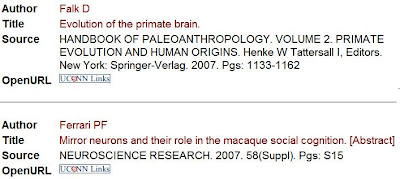
For librarians, this means that it takes advantage of OpenURL technology, and if you've registered your OpenURL resolver with WorldCat.org, it will automatically display your OpenURL resolver of choice. For researchers, if your library has done this behind-the-scenes magic, it means that if your library has the full-text of an article cited in PrimateLit, you will be able to get to it easily. Click on the "Institutional Affiliation" button on the search page to see if your institution is participating.

Here's what it looks like at UConn:
Where clicking on "UCONN Links" will ultimately lead you to the full-text of the article, if UConn has it online.

Quite impressive!

March 18, 2008

Neuroanatomy Now

Neuroanatomy seems to be hot in my podcast feed lately. Ted | Talks just featured a presentation by Jill Bolte Taylor, neuroscientist and stroke survivor.


(or read the transcript)

And my favorite brain science podcaster, Ginger Campbell, just podcast a "whirlwind (55 minute) tour of brain anatomy, based on Beyond the Zonules of Zinn: A Fantastic Journey Through Your Brain (2008) by David Bainbridge. Thanks to Dr. Bainbridge’s generosity (and permission) Ginger has embedded some of the brain anatomy figures on her podcast site, along with the author’s legends. This MRI of Bainbridge's own brain is pretty cool.

For More Information

February 11, 2008

Fun with Brains & Consciousness

I've seen a couple of fun cogsci / brain / consciousness items lately & thought I'd share them:

From Sunday's New York Times article about comedian Steven Wright comes this new joke:
“I need one of those baby monitors from my subconscious to my consciousness so I can know what the hell I’m really thinking about.”

And the LooseCannonLibrarian points me to neuroscience stamps featured on BoingBoing today:

For More Information

January 30, 2008

Confidence? Faith? Boasting?

I've been wondering about the confidence that professional athletes and politicians have been displaying lately. New York Giants wide receiver Plaxico Burress said on Monday that the Giants would beat the Patriots 23-17 in Sunday's Superbowl. (New York Times article). Rudy Giuliani said on Sunday's edition of Face the Nation that he was going to win in Florida.

I hope that the Giants beat the Patriots on Sunday, but I don't have Burress' confidence. I'm not a politician or a pollster, but I didn't think Giuliani would win in Florida. We don't know yet who will win the Superbowl, but we do know that Giuliani didn't win in Florida.

Cognitively, where does this faith, this certainty come from? Is it hormonal, like when a baby is born and the mother is immediately ready to breastfeed, and possibly even "energized"? Is there a hormone for confidence (maybe testosterone? pure speculation on my part...)

I clearly don't have it. I didn't believe the Giants could win any of their last four games, and I was right only 25% of that time, and they are in the Superbowl. And the one time I was wrong, they lost to the undefeated Patriots by only 3 points. Does my pessimism, or native New Yorker status, prime me for this lack of faith in my team? Does Plax's testosterone prime him for his belief that the Giants will prevail on Sunday?

Some cognitive scientist knows, and possibly will refer us to an article or study showing where confidence in the face of insurmountable odds comes from.

In the meantime, go Giants!

For More Information