January 14, 2007

Labels (tags) on Blogspot Blogs

Wow! Labels (aka "tags") on posts for Blogspot blogs. Just had some fun creating labels for my last 100 posts.

Take a look:


Find labels on posts that interest you, and find "more like this". Neat!

All in all, I like the new Blogger. Definitely more Safari-friendly!

January 13, 2007

Cooperative Eye Hypothesis

Story on the evolution of vision in humans & primates:
Opinion: For Human Eyes Only
MICHAEL TOMASELLO
New York Times, 1/13/07
"Trying to explain why the whites of human eyes are larger than those of other primates leads to one of the deepest and most controversial topics in the modern study of human evolution: the evolution of cooperation."

Tomasello describes some fascinating work in which he & his colleagues study how humans & primates follow their fellow's eye / head movement. Human infants, it seems, follow eye movements and ignore head movements of their mothers, while primates follow head movement and don't pay much attention to eye movement of other primates.

Why?!

Tomasello says "One possible answer, what we have called the cooperative eye hypothesis, is that especially visible eyes made it easier to coordinate close-range collaborative activities in which discerning where the other was looking and perhaps what she was planning, benefited both participants."

Browse some Google results for "Cooperative Eye Hypothesis" for more info, or check out his article in the Journal of Human Evolution; "Reliance on head versus eyes in the gaze following of great apes and human infants: the cooperative eye hypothesis." In Press, Corrected Proof, Available online 20 October 2006, by Michael Tomasello, Brian Hare, et al. ($30 for the non-library savvy, or request from Interlibrary Loan).

January 10, 2007

Usability Results Very Promising!

I spent the past year working with some colleagues on a redesign for our Research Database Locator. That's the database mechanism we use to maintain & deliver the Libraries' electronic resources to our end users.

You can see the existing product (we call it the ERM, for "electronic resource manager") -- it can be a bit overwhelming, even to those in the know.

And here is the redesigned Research Database Locator, now in beta.

It looks nothing like I thought it would, but early usabilty results indicate that it is wildly usable!

Want One


Apple's new iPhone.

Hmmm, and my current cell phone contract is up in March ...

edited to add: see David Pogue's New York Times column on the topic, and also his answers to frequently asked questions about the iPhone.

January 08, 2007

Lexicographical Timeline

Merriam-Webster has posted a nifty timeline of "Milestones in American lexicography—1806-2006", "From Noah Webster to Merriam-Webster".

Thanks to Gary Price's Resource Shelf ...

January 07, 2007

PubMed

See some notes about using PubMed at my Libraries For My Friends blog.

Welcome Darnarian


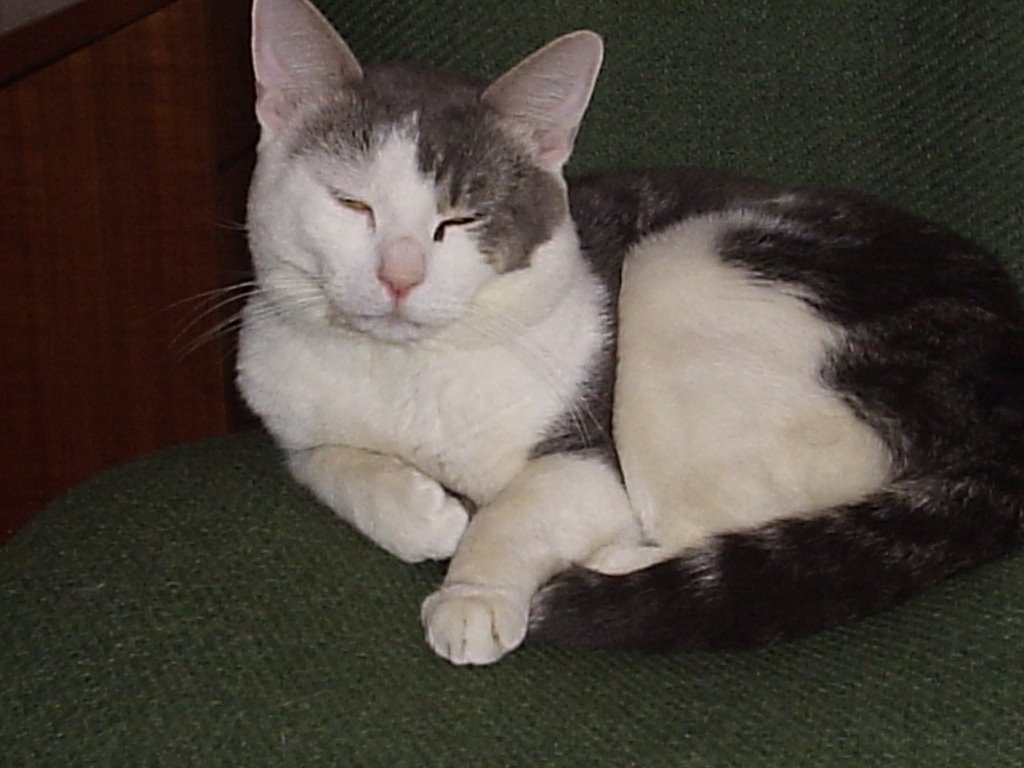
We couldn't stay a one-cat house for long, so last week, we adopted Darnarian McCats. (no relation to, but name inspired by, the Eagles' wide receiver Darnerien McCants).

We think he's mighty cute, if a wee bit stinky.

I've been reading Linda P. Case's textbook the Cat: its behavior, nutrition & health which has *lovely* illustrations of various cat behaviors. It's introductory level an is a useful primer on aspects of cat behavior -- and there is a handy (current) bibliography and list of references.

I also recommend Stephen Budiansky's The character of cats : the origins, intelligence, behavior, and stratagems of Felis silvestris catus.

But back to Darnarian. Favorite food? Any. Favorite beverage? Water. Favorite water source? Toss up between the toilet and the tub. Favorite activity? Galloping. Favorite game? mousie soccer. Age? roughly 12 months, give or take.

(eta: photo of sister Emma, who is not included anywhere in this blog. apologies & crunchies to her for the oversight)

Fiction Science

I just finished a fabulous novel: Kazuo Ishiguro's Never Let Me Go. Ishiguro wrote The Remains of the Day, and while this shares the exquisite sadness and beautifully-drawn characters of the 1989 novel, it's really nothing like it.

Never Let Me Go is more like Harry Potter meets The Handmaid's Tale. I won't say any more, because I don't want to spoil the story.

But if you like Harry Potter & Margaret Atwood, I highly recommend this one, too. Lemme know what you think.

January 02, 2007

MRI as Telescope

Great descriptive article about what an MRI is & what kinds of information can be gained from using high-end MRIs (fMRIs, DTIs, etc ...) in the Dec 2005 / Jan 2006 issue of Technology Review.

MRI: A Window on the Brain by Paul Raeburn, 12/14/2005. They say: "Advances in brain imaging could lead to improved diagnosis of psychiatric ailments, better drugs, and earlier help for learning disorders."

Raeburn quotes Robert Desimone, director of the McGovern Institute for Brain Research at MIT, who indicates that MRI is "the most powerful tool for studying the human brain. I liken it to the invention of the telescope for astronomers." Desimone notes that the arrival of the telescope did not immediately revolutionize the scientific understanding of the universe. That took time, as researchers learned how to use their new tool.

The article explains a bit about MRIs (in layman's terms!) and talks about how they could be useful in diagnosing bipolar disorder and possible problems with premature babies. Fascinating stuff.

The Technology Review web is worth checking out too ...

UConn Cog Sci Colloquia -- spring 2007

Here are the upcoming Cognitive Science Colloquia for spring 2007:


  • February 9th: Richard Ashley, Northwestern University, on musical cognition.

  • March 30th: Randy Beer, Indiana University, on coordinated behavior.

  • April 13th: Mark Changizi, Caltech / RPI, on theoretical neurobiology.


The talks will be held at 4pm on Friday afternoons at UConn / Storrs.


btw, there was an interesting article in Sunday's NYTimes about musical cognition.
Music of the Hemispheres
by CLIVE THOMPSON
Sunday, Jan. 31, 2006
eta: abridged article available free at the Toronto Star

Images from an experiment to locate the neural regions of the brain involved in listening to music. Daniel Levitin and another scientist scanned the brains of 13 people as they listened to scrambled and unscrambled versions of a tune.
"Images from an experiment to locate the neural regions of the brain involved in listening to music. Daniel Levitin and another scientist scanned the brains of 13 people as they listened to scrambled and unscrambled versions of a tune."